The rites of Umrah and Hajj take place in a few specific places around Makkah, and most pilgrims also visit Madinah. Here is each of these places: what is done there, its history and references, and what is good to know before going.
At the Sacred Mosque in Makkah
The Kaaba
A cube-shaped building at the centre of the Sacred Mosque, the Kaaba is the House of Allah towards which Muslims all over the world turn to pray. The Quran relates that Ibrahim and his son Ismaʿil raised its foundations, and describes it as “the first House [of worship] established for mankind”. The tawaf, seven circuits keeping it on one’s left, is the first rite of Umrah. It is covered by the kiswah, a black cloth embroidered with gold, renewed every year at the start of the Hijri year.
Quran 2:127; Quran 3:96-97
The Black Stone
Set in the eastern corner of the Kaaba, at about a man’s height, in a silver frame, it marks the start and end of each circuit of the tawaf. The pilgrim touches and kisses it if he can do so without pushing anyone; otherwise he points to it with his hand. ʿUmar said to it as he kissed it: “I know that you are only a stone that neither harms nor benefits; had I not seen the Prophet ﷺ kiss you, I would not have kissed you.”
al-Bukhari 1597, Muslim 1270 (ʿUmar)
The Station of Ibrahim (Maqam Ibrahim)
A small golden structure facing the door of the Kaaba, it protects the stone on which Ibrahim stood to build. After the tawaf, two units of prayer are performed there, behind it if space allows, otherwise anywhere in the mosque: “Take, [O believers], from the standing place of Abraham a place of prayer.”
Quran 2:125
The Hijr of Ismaʿil (al-Hatim)
The white semicircular low wall to the north of the Kaaba encloses a space that is part of the House: Quraysh, short of funds, had not rebuilt it. The tawaf is therefore performed outside this wall; praying inside it is praying in the Kaaba.
al-Bukhari 1584, Muslim 1333 (ʿA’ishah)
The Zamzam well
The spring gushed forth for Hajar and her son Ismaʿil in the valley, which was then deserted. The well now lies beneath the courtyard of the mosque, and its water is served free of charge throughout the mosque, chilled or at room temperature. The Prophet ﷺ said: “Zamzam water is for whatever it is drunk for”, and: “It is blessed; it is food that nourishes.”
al-Bukhari 3364 (Ibn ʿAbbas, the story of Hajar); Ibn Majah 3062; Muslim 2473 (Abu Dharr)
Safa and Marwah
The two small hills between which Hajar ran seven times in search of water are now linked by a long air-conditioned gallery, on several levels, inside the mosque. The saʿi retraces that route seven times, from Safa to Marwah, then from Marwah to Safa, with men hurrying between the two green markers. “Indeed, aṣ-Ṣafā and al-Marwah are among the symbols of Allāh.”
Quran 2:158; al-Bukhari 3364 (Ibn ʿAbbas)
References al-Bukhari 1190, Muslim 1394; Ibn Majah 1406 (the merit of prayer in the two mosques)
The sites of the Hajj rites
Mina
7 km from the Sacred Mosque
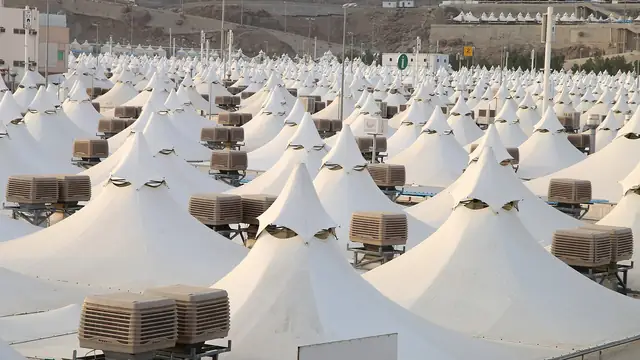
A valley between the mountains, east of Makkah, covered with white air-conditioned tents that house the pilgrims on 8 Dhul-Hijjah, then on the days of Tashriq (the 11th, 12th and 13th). Each prayer is performed there at its time, shortening the four-unit prayers, and Allah is remembered there. The Jamarat and Masjid al-Khayf are in Mina.
Quran 2:203; Muslim 1218 (Jabir)
Arafat and the Mount of Mercy
18 km from the Sacred Mosque
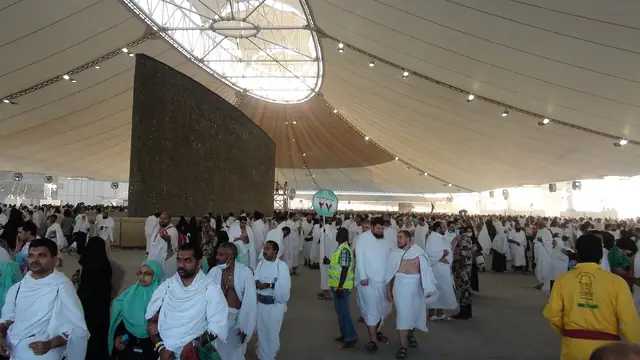
A vast plain outside the sacred territory, where pilgrims stand on 9 Dhul-Hijjah, from midday until sunset: it is the heart of Hajj. “Hajj is Arafat.” The Prophet ﷺ stood at the foot of the Mount of Mercy, near the rocks, and said: “I stood here, and all of Arafat is a place of standing.” So there is no need to climb the mount. Namirah Mosque is on the western edge: its front part is outside Arafat; signs mark the boundaries.
Abu Dawud 1949, al-Tirmidhi 889, al-Nasa’i 3016, Ibn Majah 3015 (“Hajj is Arafat”); Muslim 1218 (Jabir)
Muzdalifah and al-Mashʿar al-Haram
Between Arafat and Mina, Muzdalifah receives the pilgrims on the night of the 9th to the 10th: they pray maghrib and ʿisha combined there, sleep under the open sky and often collect their pebbles there. After the dawn prayer, Allah is invoked, at al-Mashʿar al-Haram mosque or elsewhere, until the sky grows light. “When you depart from ʿArafāt, remember Allāh at al-Mashʿar al-Ḥarām.” Between Muzdalifah and Mina, pilgrims pass quickly through the valley of Muhassir.
Quran 2:198; Muslim 1218 (Jabir)
The pillars (Jamarat)
5 km from the Sacred Mosque
Three stone walls, the small, the middle and the large pillar (jamrat al-ʿAqabah), on the western side of Mina, at which pilgrims throw seven small pebbles, saying “Allahu akbar”: the large one alone on the 10th, all three on the following days, after midday. A multi-storey bridge with one-way traffic now makes it possible to stone safely: keep to the times assigned to your group.
Muslim 1218 and 1299 (Jabir)
Masjid al-Khayf
The great mosque of Mina, at the foot of the southern mountain, where the Prophet ﷺ prayed during the days of Mina. It is open during Hajj; praying there is not a rite, but many pilgrims go there for the congregational prayers.
Around Makkah
Mount al-Nour and the cave of Hira
5 km from the Sacred Mosque
It was in the cave of Hira, near the summit of Mount al-Nour, that the Prophet ﷺ used to withdraw to worship Allah and that he received the first revelation: “Recite in the name of your Lord who created.” The climb, up a stone staircase, takes about an hour and is done early in the morning or late in the afternoon, with water. It is not a rite of the pilgrimage.
al-Bukhari 3, Muslim 160 (ʿA’ishah, the beginning of revelation); Quran 96:1-5
Mount Thawr
6 km from the Sacred Mosque
South of Makkah, the cave of Mount Thawr sheltered the Prophet ﷺ and Abu Bakr for three nights at the start of the Hijrah, while Quraysh were searching for them. “What do you think of two whose third is Allah?” The climb is long and steep.
Quran 9:40; al-Bukhari 3653, Muslim 2381 (Abu Bakr)
Al-Tanʿim, ʿA’ishah Mosque
6 km from the Sacred Mosque
The nearest point on the boundary of the sacred territory, north-west of the Sacred Mosque. Those in Makkah who wish to perform an Umrah go out there to enter ihram, as ʿA’ishah did on the instruction of the Prophet ﷺ. The mosque is equipped for getting ready; shuttles and taxis run there from the Haram.
al-Bukhari 1784, Muslim 1212 (ʿA’ishah and al-Tanʿim)
Al-Jiʿranah
Another point outside the sacred territory, to the north-east, from where the Prophet ﷺ performed an Umrah after the Battle of Hunayn. You can also enter ihram there for an Umrah from Makkah.
al-Bukhari 1778, Muslim 1253 (Anas, the Umrahs of the Prophet ﷺ)
In Madinah
Visiting Madinah is part of neither Umrah nor Hajj, but most pilgrims spend several days there. Its purpose is the Prophet’s Mosque ﷺ: “Journeys are undertaken specially only to three mosques: this mosque of mine, the Sacred Mosque and al-Aqsa Mosque.” Once there, you greet the Prophet ﷺ and visit the places he himself used to visit.
The Prophet’s Mosque
Built by the Prophet ﷺ when he arrived in Madinah, it has been enlarged over the centuries; its green dome covers the chamber where he is buried, with Abu Bakr and ʿUmar. “A prayer in this mosque of mine is better than a thousand prayers elsewhere, except the Sacred Mosque.” The visitor greets the Prophet ﷺ in front of his grave, calmly and without raising his voice, then greets Abu Bakr and ʿUmar. “No one greets me without Allah returning my soul to me so that I may return his greeting.”
al-Bukhari 1189, Muslim 1397 (the three mosques); al-Bukhari 1190, Muslim 1394 (a thousand prayers); Abu Dawud 2041 (the greeting returned)
The Rawdah
Between the chamber of the Prophet ﷺ and his pulpit, the area covered with a green carpet is called the Rawdah, the garden: “What is between my house and my pulpit is a garden among the gardens of Paradise.” Prayer there is by booking a time slot in the Nusuk app, with separate times for men and for women.
al-Bukhari 1196, Muslim 1391
Quba Mosque
3.2 km from the Prophet’s Mosque
The first mosque in Islam, founded by the Prophet ﷺ when he arrived in Madinah, about 3 km south of his mosque; a pedestrian walkway links the two. He used to go there every Saturday, on foot or riding. “Whoever purifies himself at home, then comes to Quba Mosque and offers a prayer in it, will have a reward like that of an Umrah.”
al-Bukhari 1193, Muslim 1399 (the Saturday visit); Ibn Majah 1412 (Sahl ibn Hunayf), al-Tirmidhi 324
Mount Uhud and the martyrs
4.8 km from the Prophet’s Mosque
North of Madinah, at the foot of Mount Uhud, the battle of the year 3 AH took place. Visitors greet the martyrs there, including Hamzah, the uncle of the Prophet ﷺ, who are buried facing the small hill of the archers (Jabal al-Rumat). “Uhud is a mountain that loves us and that we love.”
al-Bukhari 2889, Muslim 1392 and 1393
Al-Baqiʿ cemetery
0.5 km from the Prophet’s Mosque
Adjoining the mosque of the Prophet ﷺ on its eastern side, it holds the graves of thousands of Companions, of several wives of the Prophet ﷺ, of his daughter Fatimah according to many historians, of his son Ibrahim and of ʿUthman. The Prophet ﷺ used to go there and greet its dead: “Peace be upon you, abode of a believing people… and we shall, if Allah wills, join you.” Opening hours are limited, mainly after the dawn and afternoon prayers.
Muslim 974 (ʿA’ishah)
The Mosque of the Two Qiblahs (al-Qiblatayn)
3.8 km from the Prophet’s Mosque
According to historical tradition, it was in this mosque in north-west Madinah that a congregation learnt, in the middle of a prayer, that the qiblah was changing from Jerusalem to the Kaaba, and turned around. Visiting it is not a rite, but the place recalls a significant moment in history.
Quran 2:144
Frequently asked questions
How far is Arafat from the Sacred Mosque?
About 18 km as the crow flies, more by road. Mina is about 7 km and Muzdalifah about 12 km from the Sacred Mosque; pilgrims travel between them by coach, by the Holy Sites train or on foot.
Do you have to climb the Mount of Mercy at Arafat?
No. The Prophet ﷺ stood at the foot of the mount and said that all of Arafat is a place of standing. What matters is to be within the boundaries of Arafat on 9 Dhul-Hijjah, between midday and sunset.
Is visiting Madinah part of Hajj?
No. It is not a rite of either Umrah or Hajj, but it is a recommended visit: you travel to pray in the Prophet’s Mosque ﷺ, then greet him and visit Quba, al-Baqiʿ and Uhud.
How do you pray in the Rawdah?
You need to book a time slot in the Nusuk app; the times are separate for men and for women. Go a little before your time, with the permit displayed on your phone.
Can you visit the cave of Hira?
Yes, the climb up a stone staircase takes about an hour. It is not a rite of the pilgrimage: set off early, with water and good shoes.
What is the reward for praying at Quba Mosque?
Whoever purifies himself at home and then goes to pray at Quba Mosque has the reward of an Umrah, according to a hadith reported by Ibn Majah and al-Tirmidhi.