Hajj lasts five to six days, from the 8th to the 12th or 13th of Dhul-Hijjah, between Makkah, Mina, Arafat and Muzdalifah. Choose your type of Hajj: the guide shows, day by day and with dates, what you do, where, and what you say.
Hajj 1448: Friday, May 14 to Wednesday, May 19 2027
1
At home
Before you leave
Hajj is obligatory once in a lifetime for those who are able. Leave having settled your debts, asked forgiveness and learnt the rites.
What I do
Make sure the conditions are met: Islam, sound mind, adulthood, physical and financial ability, a safe journey.
Register through your country’s official channel (ballot, licensed agency or the Nusuk platform depending on the country): without a Hajj permit, the pilgrimage is forbidden and penalised.
Choose your type of Hajj (tamattuʿ, qiran or ifrad) with your group; plan for the sacrifice if you perform tamattuʿ or qiran.
Settle your debts, write your will, ask forgiveness, learn the rites and the supplications.
In it are clear signs [such as] the standing place of Abraham. And whoever enters it [i.e., the Ḥaram] shall be safe. And [due] to Allāh from the people is a pilgrimage to the House - for whoever is able to find thereto a way. But whoever disbelieves [i.e., refuses] - then indeed, Allāh is free from need of the worlds.
Allahu akbar, allahu akbar, allahu akbar. subhan al-ladhi sakhkhara lana hadha wa ma kunna lahu muqrinina wa inna ila rabbina la-munqalibun. Allahumma inna nas’aluka fi safarina hadha l-birra wa t-taqwa wa min al-‘amali ma tarda. Allahumma hawwin ‘alayna safarana hadha wa twi ‘anna bu‘dah. Allahumma anta s-sahibu fi-s-safar, wa l-khalifatu fi-l-ahl. Allahumma inni a‘udhu bika min wa‘tha’i s-safar, wa ka’abati l-manzar, wa su’i l-munqalab, fi-l-mali wa l-ahl
Ayibuna ta’ibuna ‘abidun, li-rabbina hamidun
(Allah is the greatest, Allah is the greatest, Allah is the greatest, How perfect He is, The One Who has placed this (transport) at our service, and we ourselves would not have been capable of that, and to our Lord is our final destiny. O Allah, we ask You for birr and taqwa in this journey of ours, and we ask You for deeds which please You. O Allah, facilitate our journey and let us cover it’s distance quickly. O Allah, You are The Companion on the journey and The Successor over the family, O Allah, I take refuge with You from the difficulties of travel, from having a change of hearts and being in a bad predicament, and I take refuge in You from an ill fated outcome with wealth and family.)(birr and taqwa: two comprehensive terms which individually, refer to all good actions and obedience i.e. performing the commanded actions and avoiding the prohibited actions. When combined together, birr refers to doing those actions which have been commanded and taqwa refers to avoiding those actions which have been prohibited.)(A successor: one who succeeds another due to the latter’s absence or death. This is the correct meaning of the word khaleefah; thus, it is incorrect to believe that Adam is the khaleefah (vicegerent, as is commonly translated) of Allah on earth because Allah is never absent, and will never die. This supplication proves the correct understanding of this term and shows that Allah succeeds us and guards whom we leave behind when we die or are absent.)(upon returning the same supplication is recited with the following addition: (We return, repent, worship and praise our Lord.))
Women, schools, mistakes and references
References
Quran 3:97
al-Bukhari 8, Muslim 16 (pillars of Islam)
Muslim 1337 (once in a lifetime)
2
At the miqat, before passing it
Ihram at the miqat
You enter ihram at the miqat with the intention of your type of Hajj, then recite the talbiyah.
Tamattuʿ : Intention for Umrah only: “Labbayka ʿumratan”. The talbiyah stops at the start of the Umrah tawaf.
Qiran : Intention for Umrah and Hajj: “Labbayka ʿumratan wa hajjan”. You stay in ihram until the 10th.
Ifrad : Intention for Hajj only: “Labbayka hajjan”. You stay in ihram until the 10th.
What I do
Bath, nails, perfume on the body (men); ihram garments: two unstitched sheets for men, modest clothes without niqab or gloves for women.
Make the intention of your chosen type (see above).
Anyone who fears being prevented (illness, accident) may add: “Fa-in habasani habisun fa-mahilli haythu habastani” (if something holds me back, I leave ihram where You have held me back).
Recite the talbiyah and repeat it often until the stoning of the large pillar on the 10th.
By plane: make the intention before flying over the miqat.
And complete the ḥajj and ʿumrah for Allāh. But if you are prevented, then [offer] what can be obtained with ease of sacrificial animals. And do not shave your heads until the sacrificial animal has reached its place of slaughter. And whoever among you is ill or has an ailment of the head [making shaving necessary must offer] a ransom of fasting [three days] or charity or sacrifice. And when you are secure, then whoever performs ʿumrah [during the ḥajj months] followed by ḥajj [offers] what can be obtained with ease of sacrificial animals. And whoever cannot find [or afford such an animal] - then a fast of three days during ḥajj and of seven when you have returned [home]. Those are ten complete [days]. This is for those whose family is not in the area of al-Masjid al-Ḥarām. And fear Allāh and know that Allāh is severe in penalty.
Labbayk Allahumma labbayk, labbayk la sharika laka labbayk, inna l-hamda wa n-ni‘mata laka wa l-mulk, la sharika lak
Here I am O Allah, (in response to Your call), here I am. Here I am, You have no partner, here I am. Verily all praise, grace and sovereignty belong to You. You have no partner.
Women, schools, mistakes and references
For women
During menstruation or post-natal bleeding: normal ihram, including the bath; everything is allowed except the tawaf.
If you make a mistake
From the moment of intention, the prohibitions of ihram apply: hair, nails, perfume, fitted stitched clothing (men), head covering (men), niqab and gloves (women), hunting, marriage, marital relations.
According to the schools
The condition (“fa-in habasani…”) is recommended for those who fear an impediment according to the Shafiʿis and Hanbalis; the Hanafis and Malikis give it no effect.
References
Quran 2:196-197
al-Bukhari 1524, Muslim 1181
al-Bukhari 5089, Muslim 1207 (the condition)
3
Makkah, the Kaaba
Arrival in Makkah
On arrival, the tamattuʿ pilgrim performs a complete Umrah; the qiran or ifrad pilgrim performs the arrival tawaf.
Tamattuʿ : Perform the full Umrah: tawaf, two units, saʿi, then shorten the hair. You leave ihram and live normally until the 8th.
Qiran : Perform the arrival tawaf (tawaf al-qudum). You may perform the Hajj saʿi straight away: it will not need repeating after the tawaf of the 10th. Cut nothing and stay in ihram.
Ifrad : Perform the arrival tawaf (tawaf al-qudum). You may perform the Hajj saʿi straight away: it will not need repeating after the tawaf of the 10th. Cut nothing and stay in ihram.
What I do
Enter the Sacred Mosque with your right foot and the supplication for entering.
Walk seven times around the Kaaba (as in the Umrah guide), then pray two units behind the Station of Ibrahim.
Then wait for the 8th of Dhul-Hijjah, praying often in the Sacred Mosque.
A‘udhu bi-l-lahi l-‘azim, wa bi-wajhihi l-karim, wa sultanihi l-qadim, min ash-shaytani r-rajim. bismi l-lah, wa s-salatu wa s-salamu ‘ala rasuli l-lah. Allahumma ftah-li abwaba rahmatik
I take refuge with Allah, The Supreme and with His Noble Face, and His eternal authority from the accursed devil. In the name of Allah, and prayers and peace be upon the Messenger of Allah. O Allah, open the gates of Your mercy for me.
The Takbîr passing the black stone
طَافَ النَّبيُّ صلى الله عليه وسلم بِالْبَيْتِ عَلَى بَعِيرٍ كُلَّمَا أَتَى الرُّكْنَ أَشَارَ إِلَيْهِ بِشَيْءٍ عِنْدَهُ وَكَبَّرَ.
Allahu akbar
The Prophet circled the Kaʿbah on a camel, every time he reached the black stone he would point to it with his staff and say: (Allah is the greatest)
Rabbana atina fi-d-dunya hasanatan wa fi-l-akhirati hasanatan wa qina ‘adhaba n-nar
The Prophet PBUH used to say between the Yemeni corner and the black stone: (O our Lord, grant us the best in this life and the best in the next life, and protect us from the punishment of the Fire.)
Women, schools, mistakes and references
According to the schools
The arrival tawaf is a sunnah for the majority and an obligation for the Malikis (qiran and ifrad). For qiran, the Hanafis require two tawafs and two saʿis; the majority, one of each.
References
Muslim 1218 (hadith of Jabir)
al-Bukhari 1562, Muslim 1211 (the three types)
4
· 8 Dhul-Hijjah · Mina
The day of Tarwiyah, in Mina
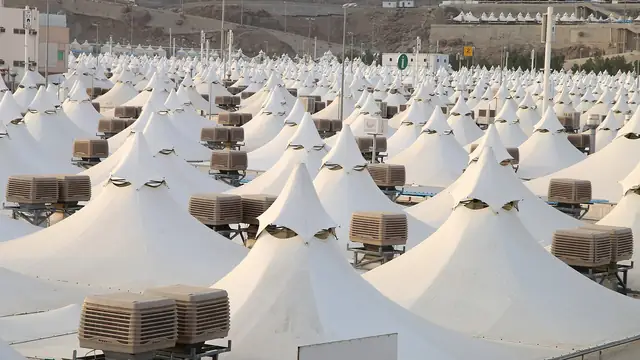
On the 8th, you go to Mina and pray the five prayers there, each at its time, shortening the four-unit prayers.
Tamattuʿ : On the morning of the 8th, re-enter ihram for Hajj where you are staying in Makkah (bath, garments, perfume for men): “Labbayka hajjan”.
Qiran : You have been in ihram since the miqat.
Ifrad : You have been in ihram since the miqat.
What I do
In the morning, go to Mina reciting the talbiyah.
In Mina, pray dhuhr, ʿasr, maghrib, ʿisha and the fajr of the 9th, each at its time; four-unit prayers are shortened to two, without combining them.
Spend the night in Mina, in supplication, Quran recitation and rest.
Labbayk Allahumma labbayk, labbayk la sharika laka labbayk, inna l-hamda wa n-ni‘mata laka wa l-mulk, la sharika lak
Here I am O Allah, (in response to Your call), here I am. Here I am, You have no partner, here I am. Verily all praise, grace and sovereignty belong to You. You have no partner.
Tip: In practice, groups often take pilgrims to Mina during the night of the 7th to the 8th, and sometimes to Arafat during the night of the 8th to the 9th: follow your group, it is not a mistake.
Women, schools, mistakes and references
According to the schools
Staying in Mina on the 8th and the night of the 9th is a sunnah according to the four schools: missing it requires no compensation.
References
Muslim 1218 (hadith of Jabir)
5
· 9 Dhul-Hijjah · Arafat
Standing at Arafat
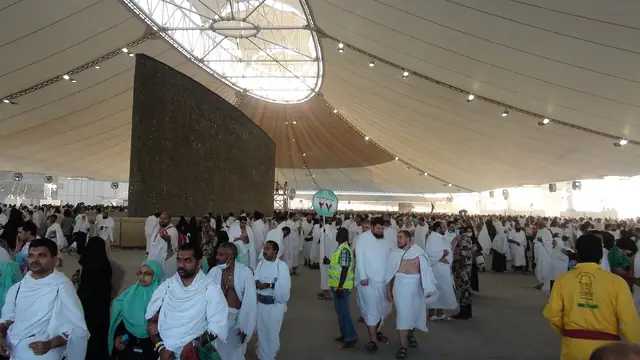
On the 9th, from midday to sunset, you stand at Arafat in supplication: it is the heart of Hajj.
What I do
After sunrise, go to Arafat reciting the talbiyah and the takbir.
Make sure you are inside the boundaries of Arafat (signs): outside them, the standing is not valid.
At dhuhr time, pray dhuhr and ʿasr combined and shortened (two units each), with one call to prayer and two iqamahs.
Until sunset, devote yourself to supplication, hands raised, facing the qiblah: ask forgiveness for yourself, your family and the Muslims, in your own language.
Say often: “La ilaha illallahu wahdahu la sharika lah, lahul-mulku wa lahul-hamd, wa huwa ʿala kulli shay’in qadir”.
There is no need to climb the Mount of Mercy (Jabal al-Rahmah) or even see it; all of Arafat is a place of standing.
After sunset, leave calmly for Muzdalifah, without praying maghrib at Arafat.
There is no blame upon you for seeking bounty from your Lord [during ḥajj]. But when you depart from ʿArafāt, remember Allāh at al-Mashʿar al-Ḥarām. And remember Him, as He has guided you, for indeed, you were before that among those astray.
Prohibited to you are dead animals, blood, the flesh of swine, and that which has been dedicated to other than Allāh, and [those animals] killed by strangling or by a violent blow or by a head-long fall or by the goring of horns, and those from which a wild animal has eaten, except what you [are able to] slaughter [before its death], and those which are sacrificed on stone altars, and [prohibited is] that you seek decision through divining arrows. That is grave disobedience. This day those who disbelieve have despaired of [defeating] your religion; so fear them not, but fear Me. This day I have perfected for you your religion and completed My favor upon you and have approved for you Islām as religion. But whoever is forced by severe hunger with no inclination to sin - then indeed, Allāh is Forgiving and Merciful.
La ilaha illa l-lah, wahdahu la sharika lah, lahu l-mulku wa lahu l-hamd, wa huwa ‘ala kulli shay’in qadir
The best of supplications is the supplication on the day of ʿArafah and the best which I and the Prophets before me have said (is): (None has the right to be worshipped except Allah, alone, without partner. To Him belongs all praise and sovereignty and He is over all things omnipotent.)
Women, schools, mistakes and references
For women
A menstruating woman performs the standing at Arafat like everyone else: only prayer is forbidden to her; she supplicates and remembers Allah.
If you make a mistake
Missing Arafat entirely means missing Hajj: you then leave ihram by performing an Umrah and make up the Hajj another year (with a sacrifice according to the majority). The great danger is heat: drink plenty, stay in the shade, do not walk in full sun.
According to the schools
The time of standing runs from noon on the 9th to dawn on the 10th (the Hanbalis start it at dawn on the 9th). Staying until sunset: an obligation for the Hanafis and Hanbalis (otherwise a sacrifice), a sunnah for the Shafiʿis according to the stronger view; for the Malikis, the pillar is to be present for a moment of the night.
References
Quran 2:198; 5:3
al-Tirmidhi 889, Abu Dawud 1949 (“Hajj is Arafat”)
al-Tirmidhi 3585 (the best supplication)
Muslim 1218 (hadith of Jabir)
Muslim 1348 (the day Allah frees most servants from the Fire)
6
Night of Saturday, May 15 to Sunday, May 16 · Muzdalifah
The night at Muzdalifah
On arrival at Muzdalifah, you pray maghrib and ʿisha together, spend the night there, then supplicate after fajr until it is light.
What I do
On arrival, pray maghrib (three units) and ʿisha (two units) combined.
Sleep: that is the sunnah; there is no special vigil that night.
Pray fajr early, then supplicate facing the qiblah, at al-Mashʿar al-Haram or anywhere in Muzdalifah, until it is quite light.
Leave for Mina before sunrise.
Collect seven small pebbles (the size of a chickpea) for the stoning of the 10th; you may also pick them up in Mina. There is no need to wash them.
There is no blame upon you for seeking bounty from your Lord [during ḥajj]. But when you depart from ʿArafāt, remember Allāh at al-Mashʿar al-Ḥarām. And remember Him, as He has guided you, for indeed, you were before that among those astray.
Then depart from the place from where [all] the people depart and ask forgiveness of Allāh. Indeed, Allāh is Forgiving and Merciful.
Al-Baqarah 2:199
Remembrance at Muzdalifa
رَكِبَ النَّبِيُّ صلى الله عليه وسلم الْقَصْوَاءَ حَتَّى أَتَى الْمَشْعَرَ الْحَرَامَ فَاسْتَقْبَلَ الْقِبْلَةَ (فَدَعَاهُ، وَكَبَّرَهُ، وَهَللَّهُ، وَوَحَّدَهُ) فَلَمْ يَزَلْ وَاقِفاً حَتَّى أَسْفَرَ جِدَّاً فَدَفَعَ قَبْلَ أَنْ تَطْلُعَ الشَّمسُ.
Allahu akbar
La ilaha illa l-lah wahdah
La ilaha illa l-lah
The Prophet rode his camel, Al-Qaswa, until he reached the sacred area (Al-Mash aril Haraam). Then he faced the Qiblah and invoked Allah, and repeatedly said the words: Allaahu Akbar (Allah is the Most Great), Allaahu Ahad (Allah is One) and Laa ilaaha illallaah (There is none worthy of worship but Allah). He remained stationary until the sky became yellow with the dawn, and then pressed on before sunrise.
Women, schools, mistakes and references
For women
Women, the elderly or weak and those accompanying them may leave Muzdalifah after the middle of the night (when the moon sets) to avoid the crowd.
If you make a mistake
Praying maghrib on the way before Muzdalifah without need: the sunnah is to wait; if you fear passing midnight, pray where you are.
According to the schools
Staying at Muzdalifah is obligatory: the night until after midnight (Shafiʿis, Hanbalis), a stop long enough to settle and pray (Malikis), a moment after dawn (Hanafis). Missing it without excuse requires a sacrifice.
References
Quran 2:198-199
Muslim 1218 (hadith of Jabir)
al-Bukhari 1676-1681, Muslim 1290-1295 (the weak leaving early)
7
· 10 Dhul-Hijjah · Jamarat, in Mina
Stoning the large pillar
On the 10th, the day of Eid, you throw seven pebbles at the large pillar (jamrat al-ʿaqabah), one at a time, saying “Allahu akbar”.
What I do
Stop the talbiyah as you begin this stoning.
Throw seven pebbles one at a time into the basin of the large pillar, saying “Allahu akbar” with each pebble.
That day, you stone only the large pillar and do not stop to supplicate afterwards.
Keep to your group’s time slot: the authorities schedule pilgrims to avoid crushes.
The Prophet PBUH said Allaahu 'Akbar (Allah is the Most Great) with each pebble he threw at the three pillars. Then he went forward, stood facing the Qiblah and raised his hands and called upon Allah. That was after (stoning) the first and second pillar As for the third, he stoned it and called out Allahu Akbar with every pebble he threw but when he was finished he left without standing at it (for supplications).
Women, schools, mistakes and references
For women
Someone ill, elderly or pregnant who cannot throw may delegate the stoning to someone performing Hajj this year.
If you make a mistake
A pebble that does not land in the basin does not count: throw another. Throwing all seven at once counts as one. Do not throw shoes or large stones.
According to the schools
Stoning begins after sunrise for the strong; the weak may do it after the middle of the night (Shafiʿis, Hanbalis).
References
al-Bukhari 1751-1753 (takbir with each pebble)
Muslim 1299 (stoning times)
al-Bukhari 1685, Muslim 1281 (end of the talbiyah)
8
· 10 Dhul-Hijjah · Mina or Makkah
The sacrifice (hady)
Tamattuʿ and qiran pilgrims owe a sacrifice: a sheep or goat, or a seventh share of a cow or camel.
What I do
Have your animal slaughtered on the day of Eid or the following days, usually through the official sacrifice coupon bought in advance with your package.
The animal must be of the required age and free of defects; you may eat from it and give some away.
If you cannot sacrifice: fast three days during Hajj and seven days once home.
And complete the ḥajj and ʿumrah for Allāh. But if you are prevented, then [offer] what can be obtained with ease of sacrificial animals. And do not shave your heads until the sacrificial animal has reached its place of slaughter. And whoever among you is ill or has an ailment of the head [making shaving necessary must offer] a ransom of fasting [three days] or charity or sacrifice. And when you are secure, then whoever performs ʿumrah [during the ḥajj months] followed by ḥajj [offers] what can be obtained with ease of sacrificial animals. And whoever cannot find [or afford such an animal] - then a fast of three days during ḥajj and of seven when you have returned [home]. Those are ten complete [days]. This is for those whose family is not in the area of al-Masjid al-Ḥarām. And fear Allāh and know that Allāh is severe in penalty.
And the camels and cattle We have appointed for you as among the symbols [i.e., rites] of Allāh; for you therein is good. So mention the name of Allāh upon them when lined up [for sacrifice]; and when they are [lifeless] on their sides, then eat from them and feed the needy [who does not seek aid] and the beggar. Thus have We subjected them to you that you may be grateful.
Bismi l-lah wa l-lahu akbar. [Allahumma minka wa laka]. Allahumma taqabbal minni
In the name of Allah, and Allah is the greatest. O Allah, (it is) from You and belongs to You, O Allah, accept this from me.
Tip: Saudi Arabia now requires payment of the sacrifice before issuing the Hajj visa: check that it is included in your package.
Women, schools, mistakes and references
According to the schools
Days of sacrifice: from the 10th to the 12th of Dhul-Hijjah for the Hanafis, Malikis and Hanbalis, until the 13th for the Shafiʿis.
References
Quran 2:196; 22:36
Fortress of the Muslim No. 246 (words of the sacrifice)
9
· 10 Dhul-Hijjah · Mina
Shaving or shortening: the first release from ihram
After the stoning (and the sacrifice), men shave or shorten their hair and women cut a fingertip’s length: everything becomes permissible again except marital relations.
What I do
Men: shave the head (best) or shorten all the hair.
Women: cut about a fingertip’s length.
You may then take off the ihram, wear perfume and your clothes: this is the first release from ihram.
Marital relations remain forbidden until the tawaf al-ifadah (and the saʿi).
Certainly has Allāh showed to His Messenger the vision [i.e., dream] in truth. You will surely enter al-Masjid al-Ḥarām, if Allāh wills, in safety, with your heads shaved and [hair] shortened, not fearing [anyone]. He knew what you did not know and has arranged before that a conquest near [at hand].
Al-Fath 48:27
Women, schools, mistakes and references
According to the schools
The Prophet ﷺ replied “Do it, there is no harm” to those who had changed the order of the acts of the 10th: this is the majority view. For the Hanafis, the order stoning, sacrifice, shaving is obligatory for tamattuʿ and qiran, and reversing it requires a sacrifice.
References
al-Bukhari 1727, Muslim 1301
al-Bukhari 1736, Muslim 1306 (“Do it, there is no harm”)
10
· 10 Dhul-Hijjah · Makkah, the Kaaba
Tawaf al-ifadah, then the saʿi
Tawaf al-ifadah is a pillar of Hajj: seven circuits around the Kaaba, two units, then the saʿi if you have not done it yet.
Tamattuʿ : The Hajj saʿi is obligatory after this tawaf (the Umrah saʿi does not count for Hajj).
Qiran : Perform the saʿi only if you did not do it after the arrival tawaf.
Ifrad : Perform the saʿi only if you did not do it after the arrival tawaf.
What I do
Walk seven times around the Kaaba in a state of wudu, without brisk walking or uncovered shoulder.
Pray two units, behind the Station of Ibrahim if possible.
Perform the saʿi between Safa and Marwah (see your type’s note).
After this tawaf (and the saʿi), everything is permissible, including marital relations.
You may perform this tawaf on the 10th or the following days, then return to Mina for the night.
Rabbana atina fi-d-dunya hasanatan wa fi-l-akhirati hasanatan wa qina ‘adhaba n-nar
The Prophet PBUH used to say between the Yemeni corner and the black stone: (O our Lord, grant us the best in this life and the best in the next life, and protect us from the punishment of the Fire.)
Inna s-safa wa l-marwata min sha‘a’iri l-lah. abda’u bima bada’a l-lahu bih
La ilaha illa l-lah wahdahu la sharika lah, lahu l-mulku wa lahu l-hamd, wa huwa ‘ala kulli shay’in qadir. la ilaha illa l-lah wahdah. anjaza wa‘dah, wa nasara ‘abdah, wa hazama l-ahzaba wahdah
(Jabir said when describing the Prophet’s pilgrimage: ‘…and when he approached mount Safa he recited: (Indeed Safa and Marwah are from the places of worship of Allah…) (I begin with what Allah began with.) so he started with Safa and climed it until he could see the Kaʿbah, he then faced it and said: (Allah is the greatest, Allah is the greatest, Allah is the greatest.) and then he would say the following three times making a supplication (one should make a personal supplication) after each time: (None has the right to be worshipped except Allah, alone, without partner.To Him belongs all sovereignty and praise and He is over all things amnipotent. None has the right to be worshipped except Allah alone. He fulfilled His promise, aided His Servant and single-handedly defeated the allies.)) (he would repeat this action at Marwah.)
Women, schools, mistakes and references
For women
A menstruating woman waits until she is pure to perform this tawaf and plans her return accordingly. If she absolutely cannot wait, she should consult a scholar: some opinions then allow the tawaf with protection.
According to the schools
Delaying it beyond the days of Tashriq requires a sacrifice for the Hanafis; the Shafiʿis and Hanbalis set no limit.
References
Quran 22:29
al-Bukhari 1733, Muslim 1211 (the menstruating woman)
Muslim 1218 (hadith of Jabir)
11
· 11 Dhul-Hijjah · Mina, Jamarat
11 Dhul-Hijjah: the three pillars
You spend the night in Mina and, after noon, throw seven pebbles at each of the three pillars, from the small to the large.
What I do
Spend the night (most of it) in Mina.
After noon, throw seven pebbles at the small pillar (the one nearest Masjid al-Khayf), saying “Allahu akbar” with each; step to the right and supplicate at length, facing the qiblah.
Throw seven pebbles at the middle pillar; step to the left and supplicate at length.
Throw seven pebbles at the large pillar, without stopping to supplicate.
And remember Allāh during [specific] numbered days. Then whoever hastens [his departure] in two days - there is no sin upon him; and whoever delays [until the third] - there is no sin upon him - for him who fears Allāh. And fear Allāh and know that unto Him you will be gathered.
The Prophet PBUH said Allaahu 'Akbar (Allah is the Most Great) with each pebble he threw at the three pillars. Then he went forward, stood facing the Qiblah and raised his hands and called upon Allah. That was after (stoning) the first and second pillar As for the third, he stoned it and called out Allahu Akbar with every pebble he threw but when he was finished he left without standing at it (for supplications).
Women, schools, mistakes and references
For women
Those who cannot throw themselves (illness, old age, pregnancy) delegate the stoning: the delegate first throws his own seven pebbles, then seven for the other person, at each pillar.
If you make a mistake
Stoning out of order (the large before the small): repeat in order. Forgetting a stoning: make it up before the end of the days of Tashriq, otherwise a sacrifice is due according to the majority.
According to the schools
Stoning on the 11th, 12th and 13th is done after noon according to the majority; some contemporary scholars have allowed it before noon in times of crowding. The nights in Mina are an obligation for the majority and a sunnah for the Hanafis.
References
Quran 2:203
al-Bukhari 1746, 1751-1753
Muslim 1299
al-Bukhari 1634, Muslim 1315 (al-ʿAbbas’s dispensation)
12
· 12 Dhul-Hijjah · Mina, Jamarat
12 Dhul-Hijjah: the three pillars, possible departure
The same as the previous day. Those who want to leave early do so after the stoning, before sunset.
What I do
Spend the night in Mina, then after noon throw seven pebbles at the small, the middle and the large pillar, with the same supplications.
Early departure: leave Mina before sunset; otherwise, stay and stone on the 13th.
Then perform the farewell tawaf before leaving Makkah.
And remember Allāh during [specific] numbered days. Then whoever hastens [his departure] in two days - there is no sin upon him; and whoever delays [until the third] - there is no sin upon him - for him who fears Allāh. And fear Allāh and know that unto Him you will be gathered.
The Prophet PBUH said Allaahu 'Akbar (Allah is the Most Great) with each pebble he threw at the three pillars. Then he went forward, stood facing the Qiblah and raised his hands and called upon Allah. That was after (stoning) the first and second pillar As for the third, he stoned it and called out Allahu Akbar with every pebble he threw but when he was finished he left without standing at it (for supplications).
Women, schools, mistakes and references
According to the schools
If the sun sets while you are still in Mina, you stay for the 13th according to the majority; for the Hanafis, you may leave until dawn on the 13th.
References
Quran 2:203 (“whoever hastens in two days…”)
13
· 13 Dhul-Hijjah · Mina, Jamaratoptional
13 Dhul-Hijjah: last stoning (for those who stay)
Those who stayed stone the three pillars one last time, after noon, then leave Mina.
What I do
Throw seven pebbles at each of the three pillars, in order, after noon.
The Prophet PBUH said Allaahu 'Akbar (Allah is the Most Great) with each pebble he threw at the three pillars. Then he went forward, stood facing the Qiblah and raised his hands and called upon Allah. That was after (stoning) the first and second pillar As for the third, he stoned it and called out Allahu Akbar with every pebble he threw but when he was finished he left without standing at it (for supplications).
Women, schools, mistakes and references
References
Quran 2:203
14
Makkah, the Kaaba
The farewell tawaf
Before leaving Makkah, you perform a last tawaf of seven circuits: it should be your last act in Makkah.
What I do
Walk seven times around the Kaaba, then pray two units; there is no saʿi.
Then leave; staying for a travel need (luggage, a meal) is not a problem.
You may drink Zamzam water and ask Allah to accept this Hajj.
Women, schools, mistakes and references
For women
A woman who is menstruating or in post-natal bleeding at the time of departure is exempt from the farewell tawaf.
According to the schools
An obligation (a sacrifice if omitted) for the Hanafis, Shafiʿis and Hanbalis; a sunnah for the Malikis.
References
Muslim 1327 (“let no one leave until…”)
al-Bukhari 1755, Muslim 1328 (exemption of the menstruating woman)
15
Madinah, the Prophet’s Mosque ﷺoptional
Visiting Madinah (optional)
Visiting Madinah is not a rite of Hajj, but most groups spend a few days there, before or after.
What I do
Pray in the Prophet’s Mosque ﷺ and greet him, as well as Abu Bakr and ʿUmar.
Pray in the Rawdah with the permit from the official Nusuk app.
Pray at Quba Mosque; visit al-Baqiʿ and Mount Uhud.
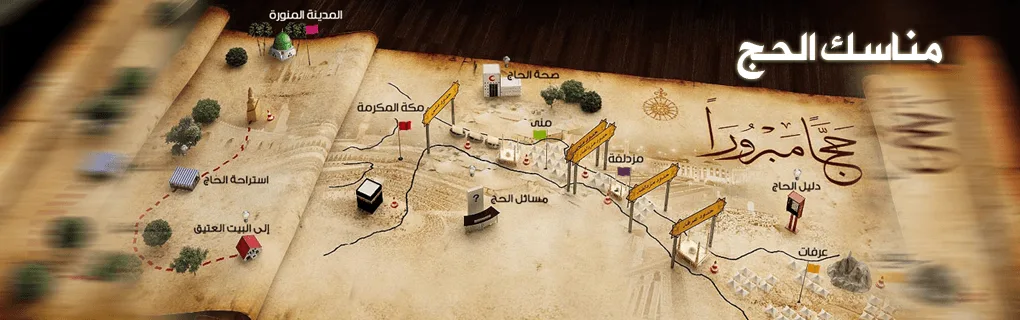
Hajj has magnificent and glorious rituals performed by the pilgrims of the Sanctified House Of Allah (Al-Kaaba) every year in different stages and in different places of Mecca and its suburbs, following the Sunnah of our Prophet Ibrahim (pbuh) and in compliance with the order of Allah the Almighty and as a sign of the glorification of His rituals, as in Allah’s saying in Surat Al-Hajj: “ Having said that, if one observes the sanctity of the symbols of Allah, then such things emanate from the piety of the hearts.” (22.32).
These rituals begin with Ihraam, which is the intention to enter into Hajj. The reason why it is called Ihraam is attributable to the temporary prohibition of a number of permissible acts for pilgrims until the end of the rituals of Hajj. The intention is the cornerstone of the ritual of Ihraam, but it requires special actions, a man in the state of Ihraam must not tie any knots or wear any stitched items, and he must shave the head, etc...
After the completion of the Ihraam ritual, pilgrims go to the second pillar of the Hajj, which is Tawaaf al-Ifadah (circumambulation of the Kaaba); it is performed on the day of Immolation (Yawm Annahr) in Makkah after Ifadah from Mina. The Tawaaf is going around the Kaaba seven consecutive times with the intention of worshiping Allah the Almighty, starting with the black stone and ending there.
Then pilgrims go to the mountains of Safa and Marwah, and they travel back and forth between them seven times, starting from Safa and ending with Al-Marwah. This ritual finds its origin in the time of Prophet Ibrahim (pbuh), where his wife Hagar was the first to travel back and forth between Safa and Marwah searching for water for her son Ismail (pbuh). In honor of this great lady, Islam has made this ritual one of the pilgrimage (Hajj).
With the completion of the Sa’y (travel back & forth) between Safa and Marwah, Muslim pilgrims will make their way from Mina to Mount Arafat. This occurs on the ninth of Dhu'l-Hijjah, where the pilgrims spend their day in Mount Arafat saying Talbiyah until sunset. This day is characterized by the Speech (Khutbah) delivered by the Imam to the pilgrims, who pray behind him Dohr and Asr combined and shortened with one call (to prayer) and two prayers.
After the stay in Arafat, the pilgrims complete their journey of faith in the holy places by proceeding to Muzdalifah, located between the sacred places of Mina and Arafat. Where pilgrims spend their night there, they perform the prayers of Maghreb and ‘Isha combined and shortened, then they collect the pebbles in preparation for stoning of the Devil (Ramī Al-Jamarāt), then they proceed to the Holy place of Mina the next morning.
And before the sun rises on the tenth of the month of Dhu Al-Hijjah, which is the day of sacrifice, Pilgrims proceed to Mina to throw the Jamrat Al- Aqaba between the periods of Forenoon and Noon, where they throw seven stones, as they repeat the words of Takbeer. After the stoning of the Devil, Pilgrims devote themselves to the slaughter of sacrificial animal, and then shave their heads or cut their hair to benefit of Tahallul Al-Asghar (first removal of Ihraam), and thus everything is permissible for them except women.
After the moving from Mina, the pilgrims have a last step to complete the pilgrimage before returning home. This step is Tawaaf Al-Wadaa’ (Farewell Circumambulation) that is performed in the same day for those who rush to travel back home soon, otherwise, this act should be postponed to the last day of the Pilgrims’ stay in Mecca. In this case, Tawaaf Al-Wadaa’ is performed in the form of Tawaaf Al-Ifadah. After completing it, the Pilgrims are prohibited from engaging in anything other than traveling.







Comments in other languages