
How to pray the eclipse prayer, step by step
How to pray the eclipse prayer, step by step
The prayer for a solar or lunar eclipse — two rak‘ahs, two bowings per rak‘ah according to the majority, and the supplications that follow.

“The sun and the moon are two of the signs of Allah; they are not eclipsed for anyone’s death or life. When you see that, pray and supplicate to Allah.” The prayer is held during the eclipse, preferably in congregation at the mosque.
By default, the school most followed by readers of this language; the views of the other schools remain visible.
The steps
-
When is it prayed?As soon as the eclipse begins, and until it ends.
SunnahSunnahSunnahSunnah
The prayer begins when the eclipse is visible and may last until it ends. People are called with “as-salatu jami‘ah” (prayer in congregation), with no adhan or iqamah.
According to the Hanafi school
For a lunar eclipse, each person prays alone at home.
According to the Maliki school
For a lunar eclipse, you pray alone, like an ordinary voluntary prayer.
According to the Shafi‘i school
In congregation, for the sun and the moon alike.
According to the Hanbali school
In congregation, for the sun and the moon alike.
The views of the four schools
- Hanafi Sunnah
For a lunar eclipse, each person prays alone at home.
- Maliki Sunnah
For a lunar eclipse, you pray alone, like an ordinary voluntary prayer.
- Shafi‘i Sunnah
In congregation, for the sun and the moon alike.
- Hanbali Sunnah
In congregation, for the sun and the moon alike.
References al-Bukhari 1044, al-Bukhari 1040, al-Bukhari 1041
- 1st rak‘ah
-
 The opening takbirRaise your hands and say “Allahu akbar”.
Make the intention for the eclipse prayer and say “Allahu akbar”.
Takbir
اللَّهُ أَكْبَرُ
Allāhu akbarAllahu akbar
Allah is the Greatest.
-
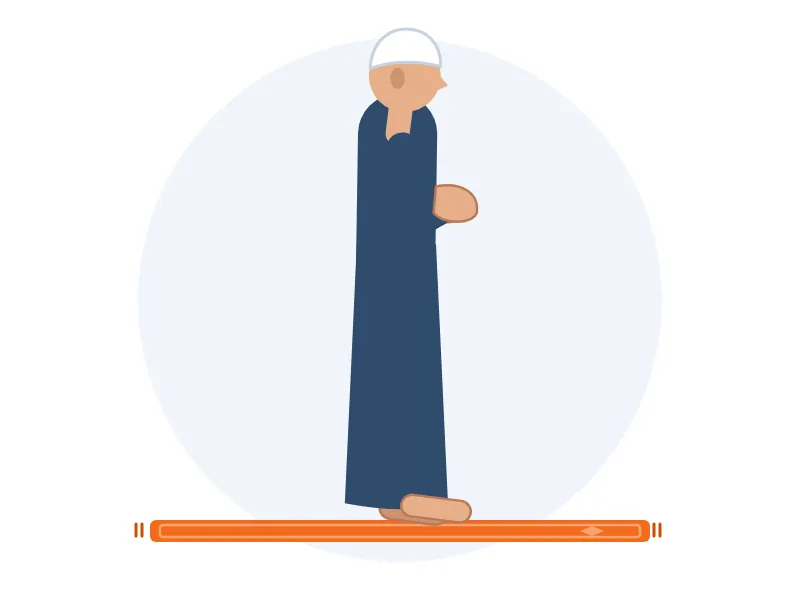 A long recitationAl-Fatiha, then a long surah, such as al-Baqarah.
Recite al-Fatiha, then a long recitation (the Prophet ﷺ recited about the length of Surah al-Baqarah).
According to the Hanafi school
The recitation is silent for a solar eclipse.
According to the Maliki school
The recitation is silent for a solar eclipse.
According to the Shafi‘i school
Silent for the sun, aloud for the moon.
According to the Hanbali school
Aloud, for the sun and the moon alike.
The views of the four schools
- Hanafi
The recitation is silent for a solar eclipse.
- Maliki
The recitation is silent for a solar eclipse.
- Shafi‘i
Silent for the sun, aloud for the moon.
- Hanbali
Aloud, for the sun and the moon alike.
-
 A long bowingBow for a long time, glorifying Allah.
Bow for a long time, repeating “Subhana rabbiya l-‘azim”.
سُبْحانَ رَبِّيَ الْعَظِيمِ. ثلاث مرَّاتٍ.
Subḥāna rabbiya l-ʿaẓīmSubhana rabbiya l-‘azim
How perfect my Lord is, The Supreme.’(three times)
-
Rise and recite againRise, then recite al-Fatiha again and a slightly shorter recitation.
Rise saying “Sami‘a llahu liman hamidah, rabbana wa laka l-hamd”, then, without prostrating, recite al-Fatiha again and a recitation a little shorter than the first.
سَمِعَ اللَّهُ لِمَنْ حَمِدَهُ.
Samiʿa l-lāhu liman ḥamidahSami‘a l-lahu liman hamidah
(May Allah answer he who praises Him.)(This supplication is to be made while rising.)
References al-Bukhari 1046, Muslim 901
-
A second bowingBow a second time, a little less long.
Bow a second time, a little less long, then rise.
سُبْحانَ رَبِّيَ الْعَظِيمِ. ثلاث مرَّاتٍ.
Subḥāna rabbiya l-ʿaẓīmSubhana rabbiya l-‘azim
How perfect my Lord is, The Supreme.’(three times)
-
 The two prostrationsRise, then make two long prostrations.
After rising, prostrate twice, for a long time, as in any prayer, then stand up for the 2nd rak‘ah.
سَمِعَ اللَّهُ لِمَنْ حَمِدَهُ.
Samiʿa l-lāhu liman ḥamidahSami‘a l-lahu liman hamidah
(May Allah answer he who praises Him.)(This supplication is to be made while rising.)
سُبْحَانَ رَبِّيَ الأَعْلَى ثلاث مرَّاتٍ.
-“Subḥāna rabbiya l-aʿla-“Subhana rabbiya l-a‘la
How perfect my Lord is, The Most High.’(three times)
- 2nd rak‘ah
-
The 2nd rak‘ah, in the same wayDo the same again, a little shorter.
The second rak‘ah is prayed like the first, each part a little shorter than the one before.
According to the Hanafi school
In the Hanafi school, each rak‘ah has only one bowing, like an ordinary two-rak‘ah prayer.
According to the Maliki school
Two standings and two bowings in each rak‘ah.
According to the Shafi‘i school
Two standings and two bowings in each rak‘ah.
According to the Hanbali school
Two standings and two bowings in each rak‘ah.
The views of the four schools
- Hanafi
In the Hanafi school, each rak‘ah has only one bowing, like an ordinary two-rak‘ah prayer.
- Maliki
Two standings and two bowings in each rak‘ah.
- Shafi‘i
Two standings and two bowings in each rak‘ah.
- Hanbali
Two standings and two bowings in each rak‘ah.
-
 Tashahhud and salamEnd with the tashahhud and the salam.
After the prostrations of the 2nd rak‘ah, sit for the tashahhud and give the salam.
Closing salutation (taslim)
السَّلَامُ عَلَيْكُمْ وَرَحْمَةُ اللَّهِ
As-salāmu ʿalaykum wa raḥmatu llāhAs-salamu ‘alaykum wa rahmatu llah
Peace and the mercy of Allah be upon you.
-
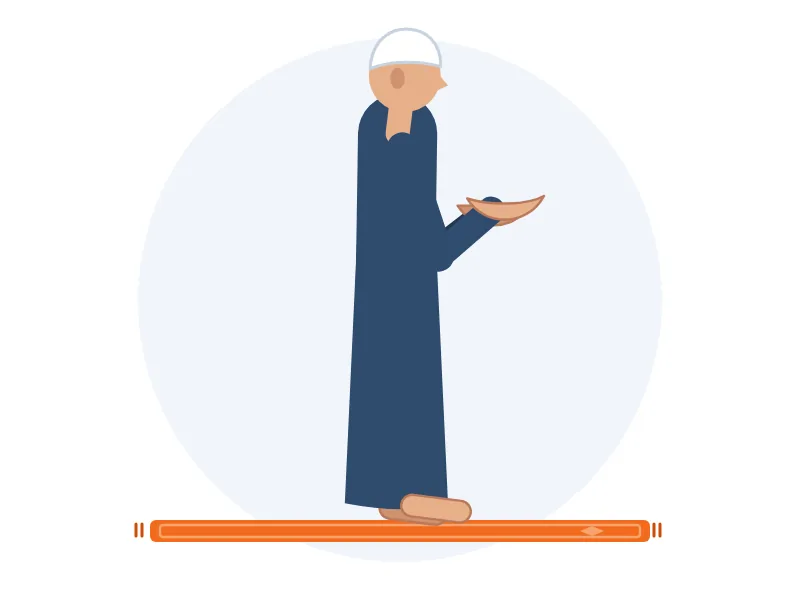 After the prayerSupplication, takbir, seeking forgiveness and charity until the eclipse ends.
The Prophet ﷺ then gave a sermon and said: “Supplicate to Allah, say the takbir, pray and give charity.” If the eclipse ends during the prayer, it is completed without lengthening it.
According to the Shafi‘i school
A sermon follows the prayer.
According to the Hanafi school
No sermon; you supplicate until the eclipse ends.
According to the Maliki school
No sermon; a reminder is permitted.
According to the Hanbali school
No obligatory sermon; a reminder is permitted.
The views of the four schools
- Hanafi
No sermon; you supplicate until the eclipse ends.
- Maliki
No sermon; a reminder is permitted.
- Shafi‘i
A sermon follows the prayer.
- Hanbali
No obligatory sermon; a reminder is permitted.
Frequently asked questions
- How many rak‘ahs and bowings?
-
Two rak‘ahs; for the majority, two bowings and two recitations in each rak‘ah; for Hanafis, a single bowing per rak‘ah.
A learning guide based on the references cited. For a particular case, ask a person of knowledge. References al-Bukhari 1044, al-Bukhari 1046, Muslim 901, al-Bukhari 1065, Abu Dawud 1193, al-Bukhari 1040, al-Bukhari 1041
Comments
No comments yet.
Log in to comment Create an account