
How to pray when you are ill, step by step
How to pray when you are ill, step by step
Praying as you are able — standing, sitting on a chair or on the floor, lying down, or by gestures, according to your school.

The prayer does not lapse as long as the mind is present, but it adapts: “Pray standing; if you cannot, then sitting; if you cannot, then on your side.” “Fear Allah as much as you are able” (64:16).
By default, the school most followed by readers of this language; the views of the other schools remain visible.
The steps
-
What does not changeEveryone prays according to their ability; the prayer stays obligatory as long as the mind is present.

You do what you can without putting yourself at risk: what you cannot do is dropped, what you can do remains. The number of rak‘ahs and the formulas do not change.
References al-Bukhari 1117, Quran, At-Taghabun 64:16, Quran, Al-Baqarah 2:286
-
 PurificationWudu if possible; otherwise tayammum; someone can help.
Perform wudu if water does not harm you; otherwise, perform tayammum. Someone can help you. A person with incontinence performs wudu at the time of each prayer.
References al-Bukhari 344
-
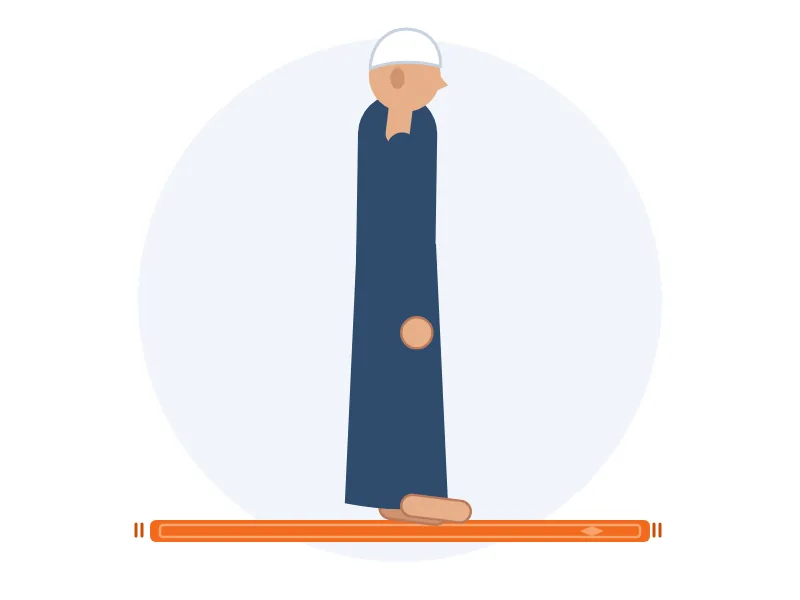 Stand as much as you canStand for the recitation, even leaning on something; sit when it becomes too hard.

Begin standing, even leaning on a stick or a wall, and sit down when the fatigue becomes too great.
-
Pray sittingSitting on the floor or on a chair, in place of standing.
Sit on the floor (cross-legged or as in the tashahhud) or on a chair, facing the qibla, and recite sitting.
According to the Hanafi school
You sit however you can; the tashahhud position is preferred.
According to the Maliki school
You sit cross-legged during the recitation.
According to the Shafi‘i school
You sit in iftirash (as between the two prostrations).
According to the Hanbali school
You sit cross-legged during the recitation.
The views of the four schools
- Hanafi
You sit however you can; the tashahhud position is preferred.
- Maliki
You sit cross-legged during the recitation.
- Shafi‘i
You sit in iftirash (as between the two prostrations).
- Hanbali
You sit cross-legged during the recitation.
References al-Bukhari 1117
-
Bowing and prostrating while sittingLean your upper body forward for the bowing, and lower for the prostration — or prostrate on the floor if you can.
For the bowing, lean your upper body forward; for the prostration, lean further, lower than for the bowing. If you can prostrate on the floor, do so. There is no need to raise something to your forehead.
-
 Pray lying on your sideOn the right side, facing the qibla; otherwise on your back, feet towards the qibla.

Lie on your right side, facing the qibla (or on the left side if that is easier). If that is not possible, lie on your back with your feet towards the qibla and your head slightly raised.
According to the Hanafi school
Lying on the back, feet towards the qibla, is preferred to lying on the side.
The views of the four schools
- Hanafi
Lying on the back, feet towards the qibla, is preferred to lying on the side.
References al-Bukhari 1117
-
Pray by gesturesBowing and prostration by a nod of the head, deeper for the prostration.
Nod your head for the bowing and nod more deeply for the prostration. If you cannot move your head, the schools differ.
According to the Hanafi school
If even nodding the head is impossible, the prayer is postponed; if the inability lasts more than a day and a night, it is not made up.
According to the Maliki school
You gesture with your eyes and follow the prayer in your heart.
According to the Shafi‘i school
You gesture with your eyes, and otherwise perform the prayer in your heart.
According to the Hanbali school
You gesture with your eyes and follow the prayer in your heart.
The views of the four schools
- Hanafi
If even nodding the head is impossible, the prayer is postponed; if the inability lasts more than a day and a night, it is not made up.
- Maliki
You gesture with your eyes and follow the prayer in your heart.
- Shafi‘i
You gesture with your eyes, and otherwise perform the prayer in your heart.
- Hanbali
You gesture with your eyes and follow the prayer in your heart.
-
Combine two prayersIf praying each prayer in its time is too hard, combining is possible according to some schools.
If praying each prayer in its own time is very hard, several schools allow combining Dhuhr with ‘Asr and Maghrib with ‘Isha.
According to the Hanafi school
No combining; you pray Dhuhr at the end of its time and ‘Asr at the start of its own.
According to the Maliki school
Combining is permitted for a sick person who fears losing consciousness or for whom it is easier.
According to the Shafi‘i school
Combining because of illness is debated in the school; several Shafi‘i scholars allowed it.
According to the Hanbali school
Combining is permitted for a sick person for whom praying each prayer in its time is hard.
The views of the four schools
- Hanafi
No combining; you pray Dhuhr at the end of its time and ‘Asr at the start of its own.
- Maliki
Combining is permitted for a sick person who fears losing consciousness or for whom it is easier.
- Shafi‘i
Combining because of illness is debated in the school; several Shafi‘i scholars allowed it.
- Hanbali
Combining is permitted for a sick person for whom praying each prayer in its time is hard.
-
Missed prayersPrayers missed during the illness are made up as soon as possible.
Prayers missed while you were conscious are made up as soon as you can, in order if possible.
Frequently asked questions
- Can I pray on a chair at the mosque?
-
Yes, when standing or prostrating is too difficult; stand for what you can, and sit for the rest.
- What about prayers during a loss of consciousness?
-
The schools differ: for Malikis and Shafi‘is, prayers whose whole time passed while unconscious are not made up; for Hanafis, they are made up if it lasted no more than a day and a night; for Hanbalis, all are made up, as after sleep.
A learning guide based on the references cited. For a particular case, ask a person of knowledge. References al-Bukhari 1117, Quran, At-Taghabun 64:16, Quran, Al-Baqarah 2:286, al-Bukhari 1115, al-Bukhari 344
Comments
No comments yet.
Log in to comment Create an account